Plum Fruit Trees
What Are Plums and Why Grow Your Own Plum Tree? Plums are delicious stone fruits produced by Prunus domestica.
Depending on the variety, the fruit can have yellow, red, purple, blue or almost black skin, with flesh ranging from golden yellow to greenish-yellow.
Plum trees also produce attractive white spring blossom before their summer and early-autumn crops develop.
There are many varieties to choose from. Dessert plums are particularly good for eating fresh, culinary plums are suited to cooking, and dual-purpose varieties offer the best of both.
Plum Trees are available grafted onto 2 Rootstocks.
St Julien A - A semi vigorous and will reach a height of 3-4 metres when mature.
VVA-1 - A dwarfing rootstock and will reach a height of 2.75-3 metres when mature.
Blackmoor Nursery has been growing fruit trees on the Blackmoor Estate in Hampshire for over 100 years.All orders are despatched in one delivery. If your order contains both bare root and container grown plants then we can only despatch when all plants are ready.
Any Bare Root Plum fruit trees - Availability means available for supply from Nov to May.
Any Container grown Plum fruit trees - Availability means vailable for supply now.
How tall will my Plum tree grow?
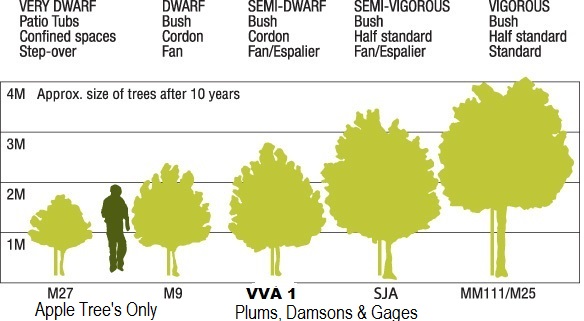
Plum Fruit trees are grafted onto rootstocks. Rootstocks come in 5 sizes (2 for Plum trees) see the chart below, all of our fruit trees are labelled using these codes.
Click to enlarge
St Julien A (SJA) - Rootstock for Plum trees.
Semi dwarfing, Approximate height 3.5-4 metres when mature.
VVA-1 - Rootstock for Plum trees. This has replaced the Pixy Rootstock.
Semi dwarfing, Approximate height 2.75-3 metres when mature.
Bare Root = Field grown trees that have been freshly lifted and supplied with no soil around the roots. Only available during the dormant period November-April.
10 Litre = Container grown and can be planted all year round. The size refers to the number of litres of compost that the container holds.
1 Year Maiden = A one year old tree and the size depends on the variety but in general they will be 100-125cm in height.
2 Year Bush = A two year old tree that has been pruned back in the first winter to form a bush shape. Generally trees will be 140-160cm in height with multiple side branches. This height guide is an end of summer height.
3 Year Bush = A three year old tree that has been pruned to form a bush shape. Generally trees will be 140-160cm in height with multiple side branches. This height guide is an end of summer height.
Fan trained Plums - Trees grow to an eventual height of around 2 m (7 ft). Although the shortest of all the forms, they will grow to a width of around 3 m and are really only a practical proposition when grown against a wall or fence.
Pollination Made Simple
Most suburban situations provide good pollen due to the close proximity of other gardens. It is not always necessary to have pollinators if the bees and other pollinating insects are generous with their visits. If you have no other Plum tree close by then select two varieties in the same group or the adjoining group ie group B and D will pollinate group C as will any others in group C. Some Plum varieties are self fertile.

 Grid

 List
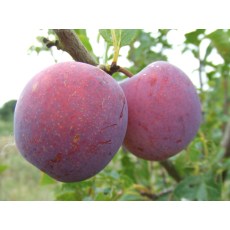
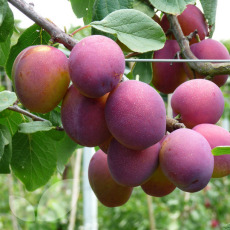
- Superb Dessert Plum – Large, sweet and juicy fruit with excellent eating quality.
- Reliable Cropping – Crops well and consistently produces good-quality fruit.
- Partially Self-Fertile – Avalon belongs to pollination group B and can produce fruit on its own, although a compatible pollination partner can improve cropping.
- Good Disease Resistance – A useful characteristic for gardeners looking for a dependable home-growing variety.
- Mid-August Harvest – An excellent mid-season garden plum with attractive red-purple fruit and golden-yellow flesh.

- RHS Award of Garden Merit – An award-winning, reliable plum variety with excellent garden performance.
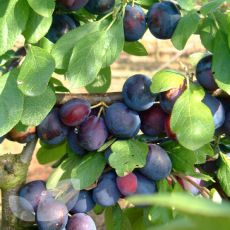
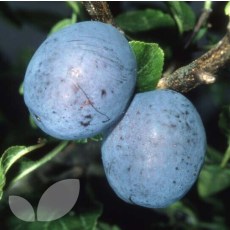
- Superb Cooking Plum – Dark purple fruit with sharp yellow flesh, ideal for pies, jams and preserves.
- Self-Fertile – Produces reliable crops without needing another plum tree for pollination. Czar belongs to pollination group B.
- Dual-Purpose Fruit – Primarily an excellent culinary plum, but also enjoyable for eating fresh when fully ripe.
- Early August Harvest – A compact, dependable variety producing attractive deep blue-purple fruit from early August.
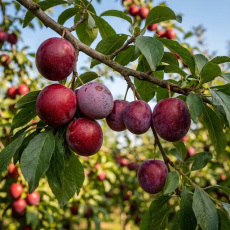
- Outstanding Dessert Plum – Produces large fruit with very sweet, juicy pale-yellow flesh and excellent flavour.
- Large Attractive Fruit – Eye-catching reddish-orange to red-purple plums make an impressive addition to the home orchard.
- Excellent Eating Quality – Regarded as a high-quality eating plum, with flavour often compared favourably with Victoria.
- Freestone When Ripe – The stone loosens from the flesh when fully ripe, making the fruit convenient for eating and preparation.
- Mid to Late August Harvest – Produces its sweet, juicy dessert plums during mid to late August.
- Pollination Group - Excalibur belongs to pollination group B.
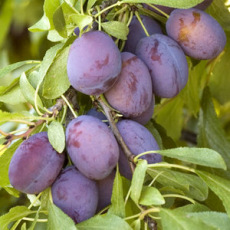
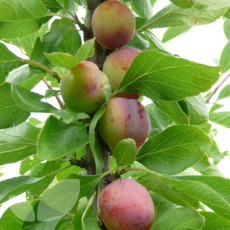
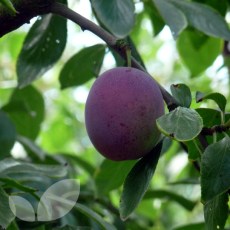
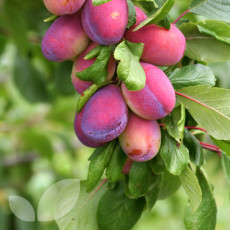
- The Nations Favourite Plum Variety - For many decades Victoria is the top selling plum variety in the UK
- Self-Fertile – Produces fruit without needing another plum tree nearby.
- Heavy & Reliable Cropper – Well known for producing generous harvests of quality plums.
- Sweet & Juicy Fruit – Delicious for eating fresh, cooking, desserts and making preserves.
- RHS Award of Garden Merit – An award-winning classic and one of Britain’s best-known plum varieties.
- Late-Summer Harvest – Produces plentiful crops of plums typically ready for picking from August into September.
Plum Fruit Trees
Why Grow Your Own Plums?
Growing a plum tree in your garden or allotment gives you the pleasure of harvesting fresh, ripe fruit directly from the tree. Plums develop their best flavour when allowed to ripen on the tree, making home growing particularly rewarding. Plum trees can produce heavy crops, while their attractive spring blossom provides additional garden interest and attracts bees and other pollinators.
They are also remarkably versatile. Depending on the variety, home-grown plums can be enjoyed fresh or used for cooking and preserving. Space doesn't necessarily prevent you from growing one. Plum trees can be grown as traditional free-standing trees, trained as fans against a wall or fence, or grown on suitable dwarfing rootstocks in large containers.
FAQs for Growing Plum Trees
Where is the best place to plant a plum tree?
Choose a warm, sunny and sheltered position with fertile soil that drains freely and doesn't become waterlogged.
Does a plum tree need another tree for pollination?
It depends on the variety. Many plums are self-fertile, so only one tree is required. Varieties that aren't self-fertile need a compatible plum flowering at a similar time.
Can I grow a plum tree in a small garden?
Yes. Where space is limited, plum trees can be fan-trained against a sunny wall or fence, while suitably dwarf trees can be grown in large containers.
When should I prune my plum tree?
Plum trees should generally be pruned during the growing season rather than while dormant, because dormant pruning increases the risk of silver leaf infection. Blackmoor advise pruning established plum trees in July to August.
When are plums ready to harvest?
Harvest time varies according to the variety, with plum crops generally ripening from summer into early autumn. For the best flavour, allow the fruit to ripen on the tree where practical.
Are plum trees difficult to grow?
Plum trees are easy to grow. Once established, they require relatively little maintenance apart from annual pruning and can reward you with plentiful harvests for many years.
Why Buy Plum Trees from Blackmoor Nursery?
When you buy a plum tree, the quality of the tree and the knowledge of the nursery behind it matter. Blackmoor Nursery has been growing fruit trees on the Blackmoor Estate in Hampshire for over 100 years.
We specialises in fruit trees and soft fruit plants and offers gardeners the opportunity to buy fruit plants directly from the grower.
Blackmoor grows fruit trees in a range of sizes and forms, including bush, cordon, espalier and fan-trained trees, with trees grafted onto different rootstocks so customers can select an appropriate eventual tree size for their garden.
Blackmoor's fruit trees are subjected to quality checks throughout the growing, lifting and packing process, and our nursery team can provide advice on choosing and growing fruit trees.
With more than a century of fruit-growing experience in Hampshire, Blackmoor Nursery combines specialist knowledge, an extensive choice of fruit trees and generations of nursery experience, making it an excellent place to choose a plum tree for your garden or allotment.